
Purple Needlegrass
Stipa pulchra
Grass Family (Poaceae)
Native
Key Identifying Characteristics
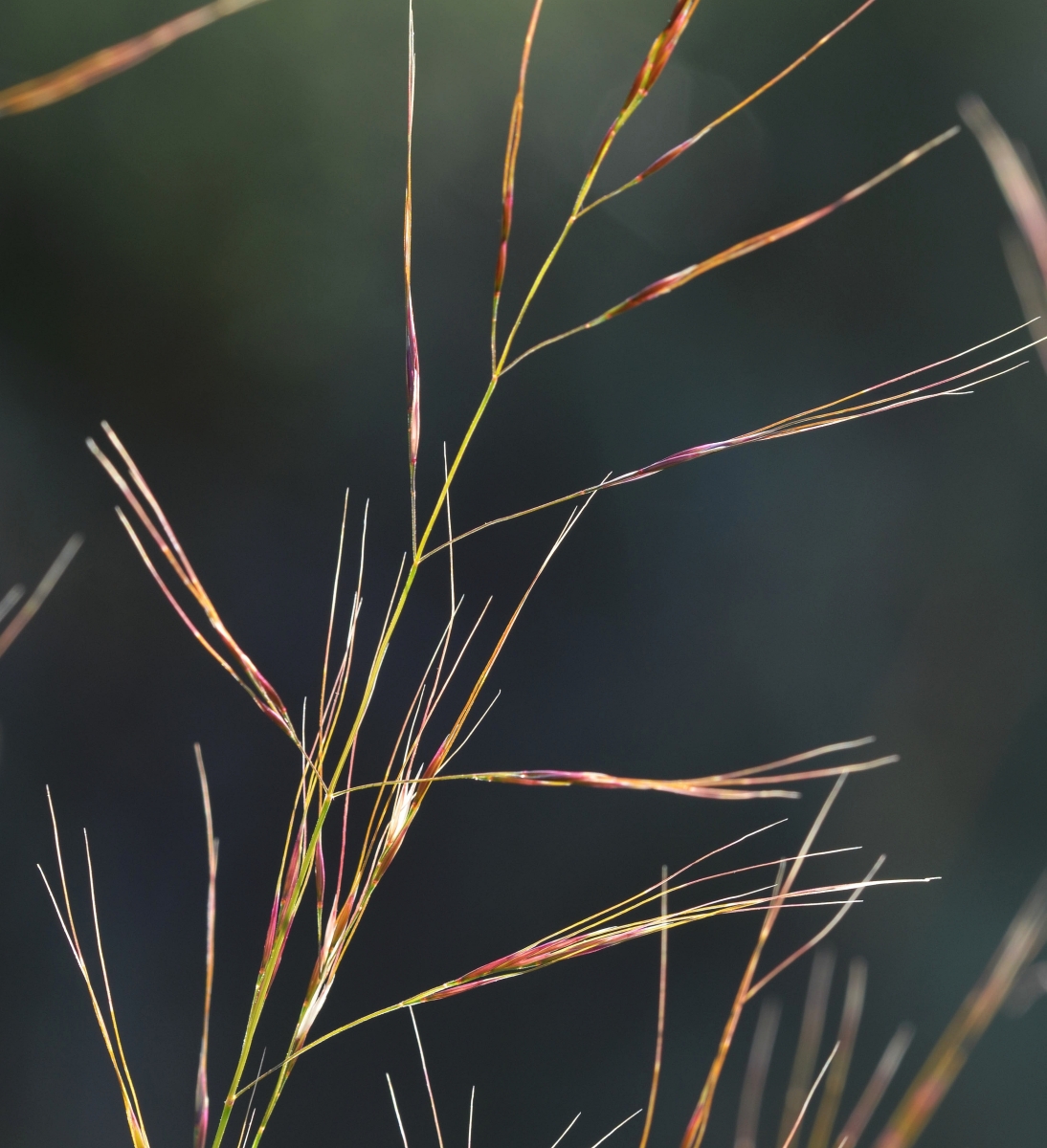
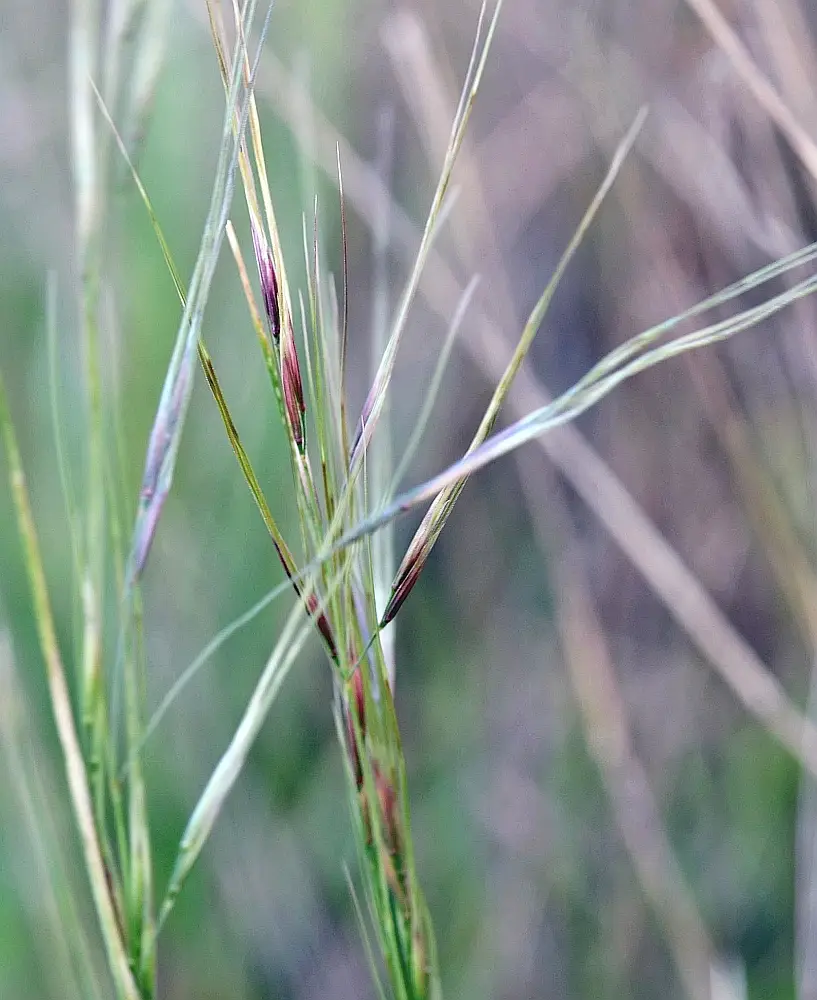
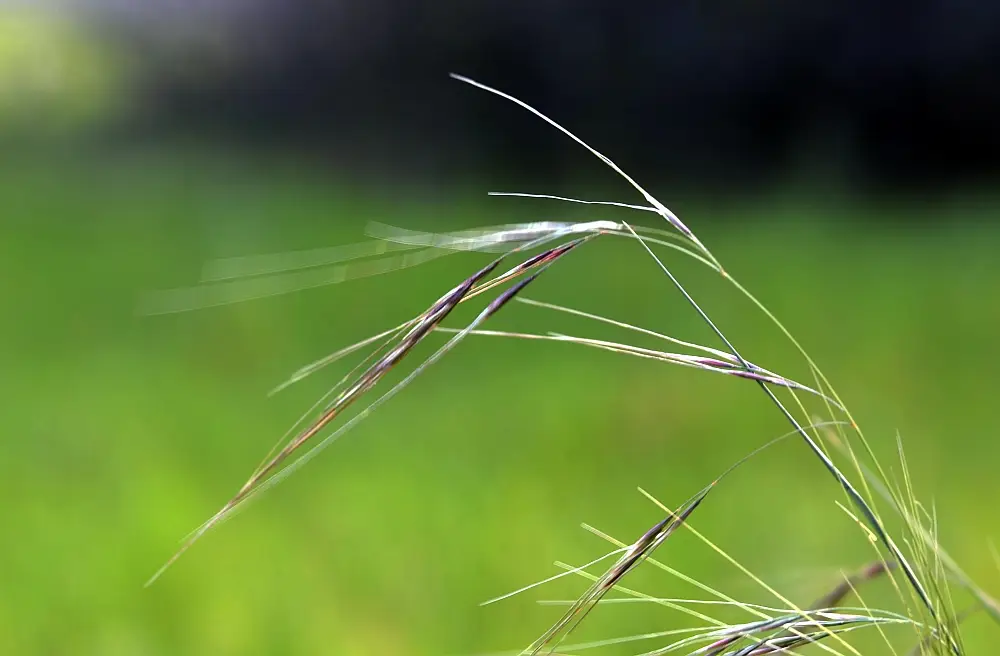
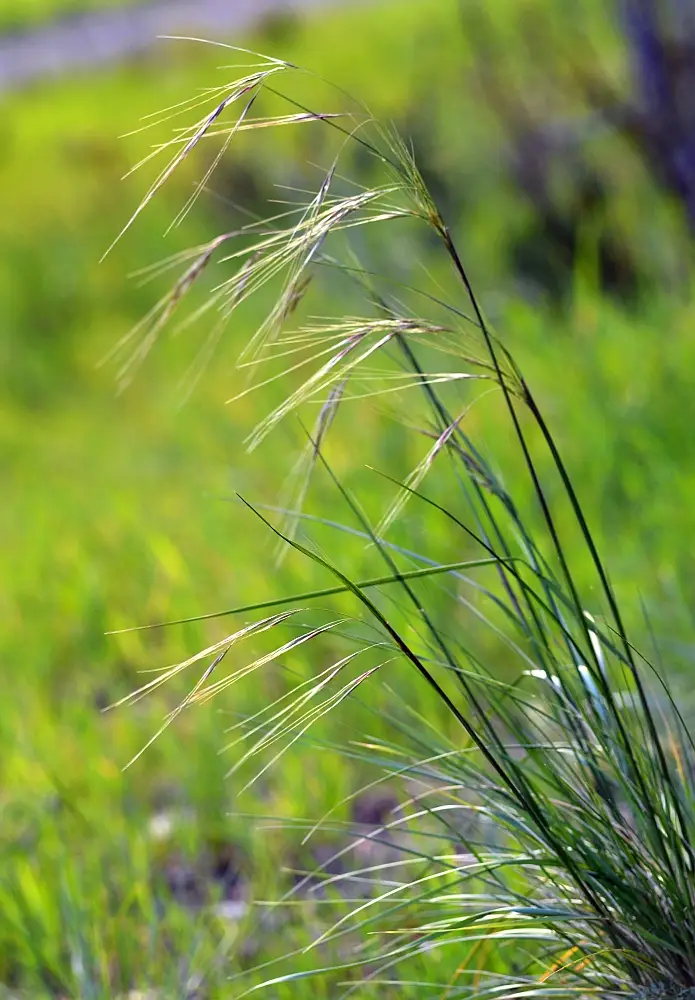
Perennial bunch grass with unbranched stems and purple spikelets with long awns (stiff, hair-like appendages). The “needles” of purple needlegrass are the long awns which range from 1.5 to 4 inches. Deeply rooted plants, from 2 to 6 feet deep.
Similar To
Purple Needlegrass (Stipa pulchra) can be confused with the non-native, invasive ripgut brome (Bromus diandrus). S. pulchra is a perennial bunchgrass, while B. diandrus is an annual grass. S. pulchra has purple coloration along portions of the florets, whereas B. diandrus is consistently green. One quick way to tell them apart is to run your fingers across the top of the spike. S. pulchra tends to be smooth and glabrous, whereas B. diandrus is scabrous and rough to the touch.
Height / Size
3 feet tall 2 feet wide
Leaves
Leaves radiate from the root crown and wrap the stem in a sheath. Leaves are flat or curve upward at the edges (margins inrolled). Sheaths not hairy (glabrous) to hairy. Leaves are 4 to 8 inches long.
Inflorescence
Inflorescence is open and branched, from 7 to 24 inches long, with many drooping spikelets. Spikelets are purplish and contain one floret with a long awn. Spikelets are so heavy that the grass bends over at the top and droops, waving in the wind.
Awn is twice bent (bigeniculate) sometimes refered to as a “knee”. The knee is formed due to a reverse twist in the awn. This means the awns of purple needle grass change direction twice.
Bloom time: March to June.
Seed
Awns are persistent, staying on the pollinated floret as it matures. Seeds disperse themselves via awns twisting in response to humidity (hygroscopically). These awns also help them embed themselves in the soil. Seeds also disperse via animals (epizoochory) inadvertently when they get stuck in an animal’s fur.
Habitat
Oak woodland, chaparral, grassland.
Location / Range
Valley View Trail, Weiler Ranch Trail. Distributed from Northern California to Baja California and inland as far as the Sierra foothills.
Lifespan
Purple Needlegrass is a perennial and can live for over 100 years.
Fascinating / Fun Facts
Purple Needlegrass was named California’s state grass in 2004. Before European colonization, Purple Needlegrass was the dominant grass in California.
Ethnobotany
Indigenous California peoples use this grass for food, by grinding parched seeds into flour, and for making baskets.
Sources
Botanical Society of America
Calflora
Calscape
iNaturalist
Jepson eFlora
PlantID.net for San Pedro Valley CP (NRDB.org)
VanderWerf, Barbara. 1994. Montara Mountain. Gum Tree Lane Books, El Granada, CA.
State of California Capitol Museum
Anderson, M.K. 2005. Tending the Wild. University of California, Berkeley. Pp. 255-261.